Digital printing in Wellington covers most of what offices, law firms and event teams order from us. Offset printing is for the big runs. Here’s how to tell which one your job needs, so you can plan ahead and avoid surprises.
Digital printing: most jobs start here
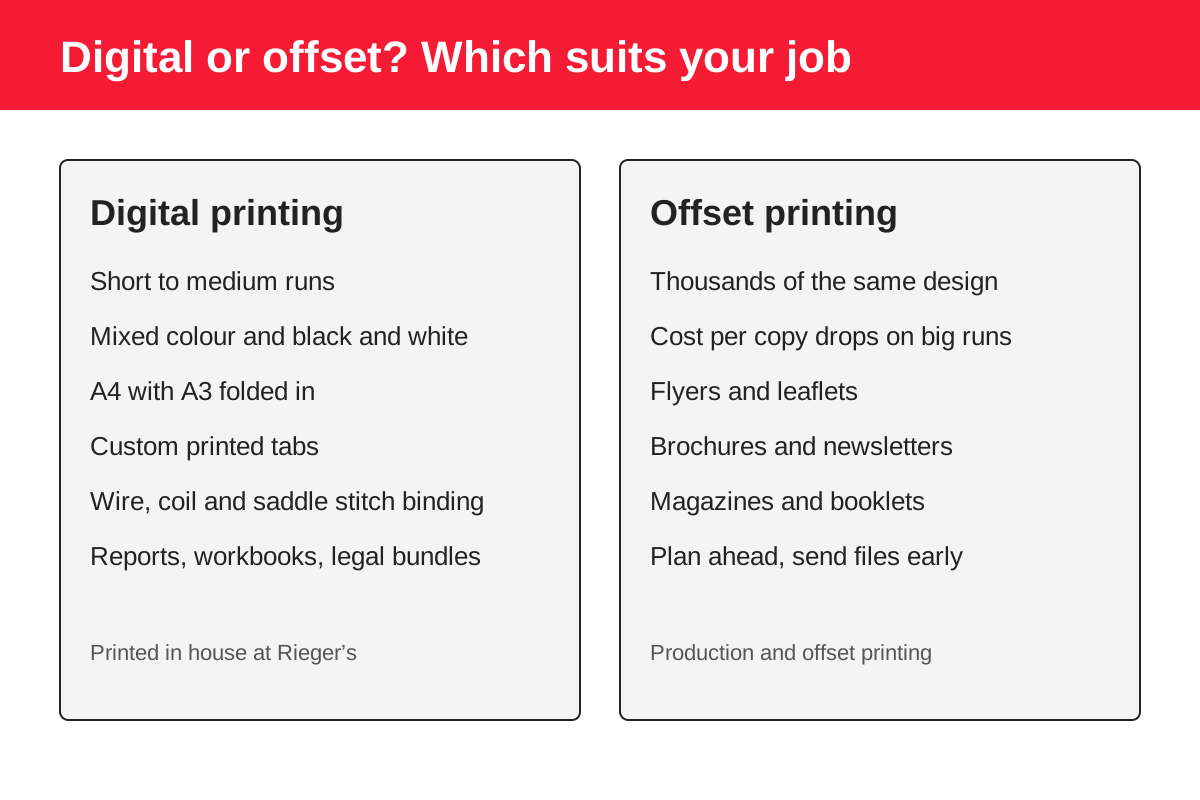
Most of our jobs are printed in house on our digital printers. We have three large colour laser printers and two high speed black and white printers, plus many stocks and finishes. Digital suits short and medium runs, and it suits documents that need careful assembly. Think reports, training workbooks, conference packs, proposals, annual reports and legal bundles.
What we can put together in one digital document
Because we print and finish in house, we can keep an eye on a document from the first page to the last. In one document we can offer:
- A mix of colour and black and white pages, so you only pay for colour where you need it.
- A4 documents with A3 pages folded in.
- Custom printed tabs.
- Wire binding (8mm to 32mm), black plastic coil (8mm to 51mm) or saddle stitch for booklets. Documents of up to 450 pages can be bound as one.
- Guillotining, hole punching, folding and laminating, depending on the job.
Before it leaves us we check that the pages are in order and that the finishing looks tidy. Our printing and finishing is the last step, so please send us final files you’re happy with.
Offset printing: thousands of copies
Offset printing, which we also call production printing, is for thousands of copies of the same design. The more you print, the cheaper each copy becomes, which is why it suits flyers, mail drop leaflets, brochures, newsletters and magazines. Offset jobs take more planning, so please talk to us early. You can read more on our production and offset printing page.
Offset files need to be print ready. If you’re not sure what that means, our guide to crops and bleeds explains how to set up artwork that trims cleanly. Please keep important text and logos well inside the trim edge so they’ll look tidy once the job is cut.
How to choose between digital and offset
- Quantity: hundreds or fewer points to digital. Thousands of the same design points to offset.
- Content: if pages change within the document, such as mixed colour and black and white or tabbed sections, digital is the better fit.
- Finishing: tell us if you need binding, tabs or folding, and we’ll suggest what works.
- Timing: both need planning. Send files early and we’ll confirm a timeframe with you.
We’re assuming your files are final. If the artwork might still change, let us know before we start, because changes are much easier before a job is set up.
What to send us
- A final PDF, ready to print.
- The finished size. If you’re unsure, our guide to common paper sizes will help.
- The quantity. A rough range is fine.
- The binding and finishing you want.
- The date you need it by, with as much notice as you can give.
We don’t publish a price list because the cost depends on quantity, stock and finishing. Send us the details through our job enquiry form and we’ll quote. Our post on choosing price over reliability explains why we focus on getting the job right. See our print services page for everything we offer.
Common questions
How many copies is too many for digital printing?
There isn’t one number that suits every job. When you’re looking at thousands of copies of the same design, ask us about offset printing. We’ll tell you which makes more sense for your job.
Can digital printing handle colour and black and white pages in one document?
Yes. We can mix colour and black and white pages, and put together documents that have A3 pages folded into an A4 document.
How far ahead should I send my job?
As early as you can. Most jobs are turned around in one or two days, and larger jobs are planned with you. We no longer do jobs while you wait, so sending files early is the best way to avoid a rush.
Any questions please let us know. Thanks.